
Listening from the Front Lines
How one UVA student turned experience into inquiry
Annaliese Meistrich (BSN ’26) spent her high school years serving as an EMT, gaining early exposure to the realities of crisis care. After transferring to the University of Virginia, she made the decision to pursue nursing, influenced by her experiences at Sentara Martha Jefferson Hospital’s emergency department, where she worked closely alongside nurses and observed their pivotal roles in patient care.
During her first semester at UVA, Annaliese was drawn to the School of Nursing in a way that felt familiar and inviting. “It seemed really tight knit,” she recalls. “I would see the students walking around Grounds in their scrubs and it just seemed magical to me.”
She enrolled in the traditional Bachelor of Science in Nursing program as a second-year student. She worried it might be hard coming in a year older than her peers but quickly found her place. “There were a lot of other people like me in the cohort as well,” she says.
Seeing Patients as People
As Annaliese progressed through the program, she found that specific coursework sharpened what was already her core philosophy of care.
An ethics course in clinical practice with Ashley Hurst proved especially formative. “It changed how I thought about patients,” Annaliese says. “We talked about difficult things that we can encounter as nurses, and I think this will make sense when I tell you I want to go into hospice nursing.”
That perspective reflects how she naturally approaches patients. “I just really see patients as people. I always have, way before I even see them as someone who is sick or injured in a bed. I love to talk to people.”
I just really see patients as people. I always have, way before I even see them as someone who is sick or injured in a bed.
Annaliese Meistrich
In nursing, she notes, it can be easy to be overly focused on the hospitalization itself. “I care so much about the before and after. That is my passion, and Professor Hurst’s class brought that aspect front and center.”
A psychiatric nursing course further expanded Annaliese’s thinking. The class ran concurrently with clinical rotations, something she found especially impactful. “You get the duality of learning the material and seeing it in real life,” she explains. While completing clinicals on UVA Hospital’s inpatient behavioral health unit, she began connecting theory with lived experience.
“It is a tough place to be,” Annaliese says. “The conditions can't just be fixed in the O.R.” Being there, she says, sparked ideas that would ultimately become the research of her Distinguished Majors Project.
Asking Different Questions about Crisis Care
As an EMT, Annaliese had already seen the complexity of behavioral health emergencies before patients ever reached the hospital.
“Emergencies like substance abuse, psychosis, and domestic disputes don’t necessarily have a clear treatment path the way some other types of emergencies do,” she explains. At the scene, the response often comes from police officers, firefighters, or EMTs—professionals who often know nothing about the individual.
“Professionals with patient history, such as psychologists and therapists, don’t show up to the scene. Doctors and nurses with specialized mental health training aren’t there either,” she says. “First responders can attempt to de-escalate the person in crisis, but it is a challenging situation.”
Emergencies like substance abuse, psychosis, and domestic disputes don’t necessarily have a clear treatment path the way some other types of emergencies do.
Annaliese Meistrich
Those realities led Annaliese to ask new questions. What do pre-hospital providers experience during behavioral health emergencies? What are the challenges they face? How might better collaboration across agencies support both patients and responders, especially given the toll this work takes?
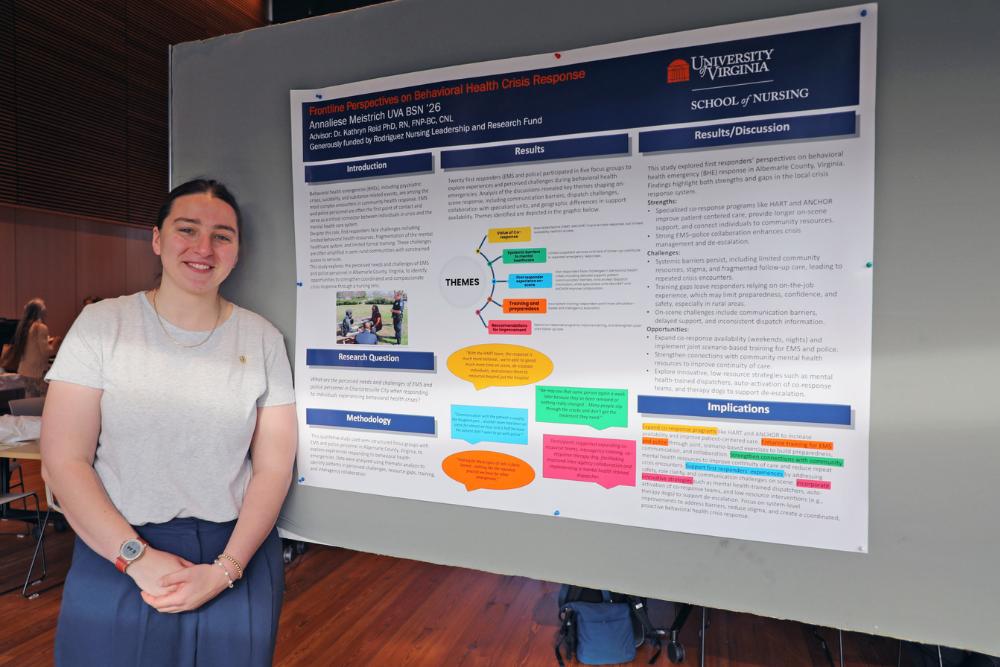
These questions became the foundation of her Distinguished Majors Project (DMP), a rigorous fourth-year thesis opportunity that allows undergraduate students at the School of Nursing to conduct original research.
Studying Co-Response Models in Action
For her project, Annaliese connected with co-response units operating locally, including ANCHOR (Assisting with Navigation, Crisis Help, and Outreach Resources) in the city of Charlottesville and HART (Human Services Alternative Response Team) in Albemarle County.
ANCHOR brings together law enforcement officers, firefighters, medical professionals, and mental health professionals to respond to calls involving individuals experiencing behavioral health crises. The team aims to de-escalate situations, assess needs, and connect people with appropriate services instead of defaulting to arrest.
HART similarly responds to and follows up on emergency calls involving mental health and substance use through a collaborative, trauma-informed, human-centered approach.
“These co-response units are new within the last few years and have been well received by first responders,” Annaliese says. “My research shows they want more of them.”
Annaliese's research drew on focus groups and interviews with first responders, giving voice to frontline perspectives and gaps in the current system.
Her research drew on focus groups and interviews with responders, giving voice to frontline perspectives and gaps in the current system.
“What if I told you we can’t help someone you know who is affected by cancer until they reach stage four?” she says. “You’d think that was crazy.”
Structural barriers, including lack of insurance and limited access to providers, often delay timely care. “With other diseases, when you first see a marker, some type of treatment is begun,” she says. “With mental health, people are suffering every day and it gets pushed off until it is a full-blown crisis.”
From Findings to Recommendations
Annaliese devoted a significant portion of her project to future-focused recommendations. These included involving a mental health professional earlier, even at the point of dispatch, to help screen emergency calls and better inform responders.
Responder safety also emerged as a critical issue, particularly in rural areas where backup may not be immediately available.
She explored creative, relatively low-cost ideas as well, including therapy dogs. “You’re having the worst day of your life,” she says. “Someone shows up and they have a dog, which the vast majority of people like and respond to. It calms people down.”
At the core of her work is a human-centered principle. She believes individuals in crisis should be treated as people who are capable of de-escalating, not as criminals or community threats by default.
“I have a whole section in my discussion and results section that talks about recommendations for the future based off of the focus groups and interviews,” she says. While the findings are location-specific, she believes they could inform similar communities.
A Passion Project from Start to Finish
Annaliese had previous research experience as a summer intern at the Office of Nursing Research, and she spent a month in Nicaragua doing qualitative research with one of Dr. Emma Mitchell’s teams. But the Distinguished Majors Project (DMP) was different.
“The DMP was going to be my passion project, from start to finish, over the course of a year,” she says. “There was a lot of freedom with it.”
Annaliese designed the study herself, conducted all the focus groups, and worked independently with guidance from her DMP advisor, Kathryn Reid. “We met each week and Professor Reid would offer feedback. But she let me completely steer the ship. I designed all of it myself and conducted all the focus groups. I have hundreds of pages of data.”
“Annaliese has such a promising future as a nurse, as a scholar, and as a leader,” says Kathryn. “She has seized every single opportunity to make this project bigger than herself.”
Kathryn notes that Annaliese applied for and received a grant from the Rodriguez Nursing Leadership and Research Fund to support her work, helping pay for her poster presentation and possibly production of badge buddies for volunteer agencies. She also submitted her abstract and was selected to present at the Virginia Nurses Association conference and UVA’s Compassionate Care Research Symposium.
“Annaliese has done a wonderful job of pulling stakeholders together,” Kathryn adds. “She has the ability to connect with others and follow through. That’s real leadership.”
A Rare Opportunity for Undergraduate Nurses
“We’ve had the DMP for many years at the School of Nursing, and it’s an opportunity for students in their fourth year to do a thesis project,” Kathryn says.
Students apply in the spring of their third year and must meet GPA requirements. Once accepted, they develop a research question, conduct a literature search, synthesize findings, and design their methods. After IRB approval in the fall, students implement their research, analyze data, and write their results in the spring, culminating in both a presentation and a manuscript draft for potential publication.
Kathryn notes that while BSN-prepared nurses are expected to understand research, conducting original research as an undergraduate is rare. “It is a really unique option at UVA School of Nursing,” she says.
From Discovery to Impact
Annaliese’s journey highlights how undergraduate research at the UVA School of Nursing can be a meaningful part of the student experience. Through close collaboration with faculty mentors, she contributed to ongoing research and later led her own original project, building skills that extend past methodology, including problem solving, adaptability, and creative thinking. Supported by mentorship, donor investment, and hands‑on training, her work illustrates how early research engagement can shape both inquiry and career paths.
For Annaliese, the experience expanded how she sees her own future. “It opened the door for me to even consider doing a PhD,” she says. Beyond research skills, she discovered confidence in her ability to think creatively, adapt, and work through complex problems. She encourages nursing students to take on opportunities that challenge them, even when they are optional, because that is often where the most unexpected growth occurs.
